
Today we're announcing that Mulga Defense Corporation is now an official Cisco partner, accepted into the Cisco 360 Partner Program. The milestone follows the validation of Spinifex, our open-source AWS-compatible cloud, on Cisco Unified Edge hardware. This combination creates an AWS-compatible cloud on AI-ready edge hardware, out of the box.
Edge computing has moved from a back-office concern to a strategic one. Latency budgets, data sovereignty regulation and the cost of backhauling data to a region are pushing inference and operational workloads out to where the data is produced — retail floors, hospitals, factory lines and branch sites. The hardware built for that shift was not designed to run the AWS estate most enterprises have spent a decade building.
Cisco Unified Edge is the enterprise-grade hardware for that shift. Spinifex, our AWS-compatible cloud runtime, lets the workloads already written against AWS — Terraform, Kubernetes, S3 and the pipelines around them — run on it unchanged, with no dependency on a public cloud region. This partnership makes that pairing a validated, supported combination.
Why Cisco Unified Edge
Cisco Unified Edge is Cisco's AI-ready edge computing platform, a full-stack platform that brings compute, networking, storage, and security into a single modular chassis for real-time AI inference outside the data centre. The hardware is the 3RU, short-depth Cisco UCS XE9305 chassis: up to five hot-swappable sled nodes — Xeon 6 SoC compute, GPUs, NVMe storage, and a Cisco 8255 secure-router node — managed as a fleet through Cisco Intersight, and aimed at real-time AI where the data centre can't reach: retail floors, hospitals, factories, and branch sites.
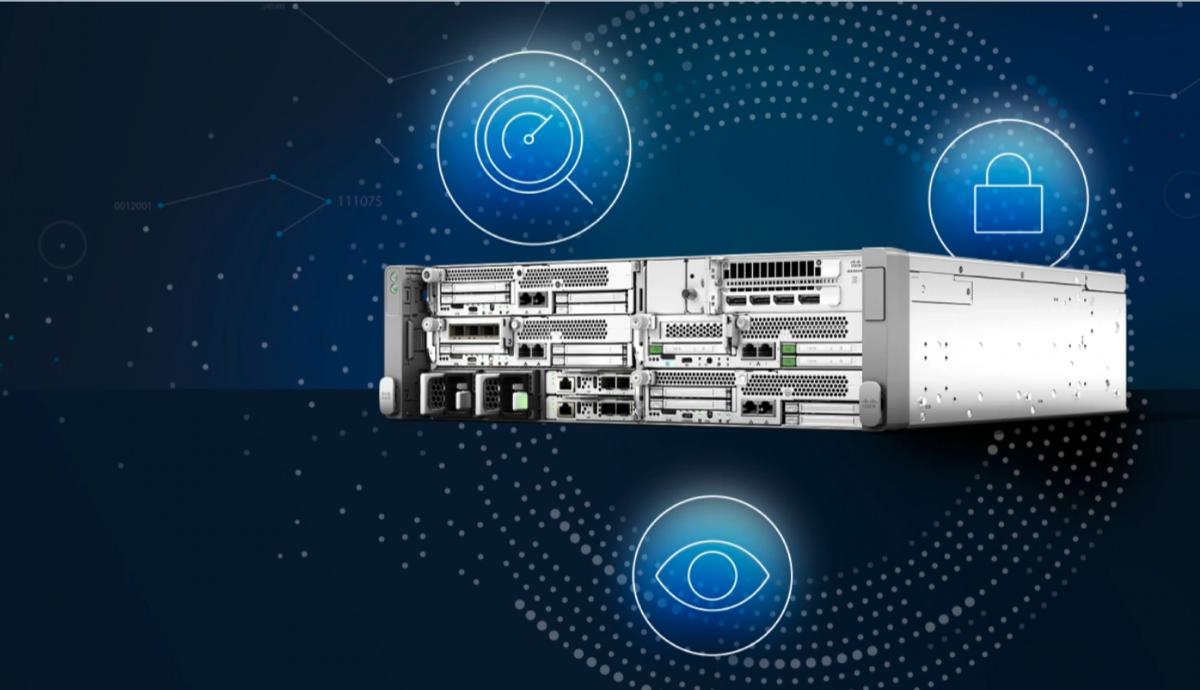
What makes Unified Edge a strong substrate for Spinifex is how its design lines up with an edge-cloud workload:
- Converged compute, storage, and networking in one box. The XE9305 chassis takes up to five sled nodes: XE130c and XE150c M8 compute on Intel Xeon 6 SoC (12/20/32-core, up to 768 GB–1 TB memory), up to four E3.S NVMe SSDs for 120 TB of storage, dual 25G NICs, and a Cisco 8255 secure-router node. Spinifex maps straight onto it — EC2 on the compute nodes, EBS and S3 (via our erasure-coded Predastore) on the NVMe, VPC across the built-in networking. The full AWS primitive set bundled in one chassis.
- GPU-ready for inference at the edge. The XE130c takes a 75 W GPU; the XE150c takes full-height GPUs including NVIDIA RTX PRO. Spinifex passes them through to guest VMs at near-native performance for vision, signals, and RAG pipelines, and the Xeon 6 SoC's CPU-native inferencing runs smaller models with no GPU at all.
- Scales inside a single 3RU chassis. Five front slots mean you start with one compute node and grow to a multi-node cluster in the same box. Spinifex scales the same way, from a single-host cloud up to an HA cluster with erasure-coded object storage, so you can add capacity without changing the platform.
- Interoperability without a rewrite. AWS workloads lift and shift unchanged: EC2, EBS, S3 and VPC behave as they did in-region, Terraform targets the UCS platform the way it targeted us-east-1, and the AWS-native pipelines around them deploy as-is. Only the endpoint changes.
- Enterprise security and fleet management, built in. Unified Edge ships designed-in, embedded zero-trust security with tamper-resistant hardware, and Cisco Intersight provides SaaS-based, zero-touch fleet management across every site. Spinifex layers AWS-compatible IAM and STS on top, so access control and audit use the policies your team already writes.
Spinifex also runs standalone, in air-gapped deployments and anywhere data sovereignty rules out a dependency on an external control plane. The same platform covers both cases, so a connected site and an isolated one are operated the same way.
The stack, end to end
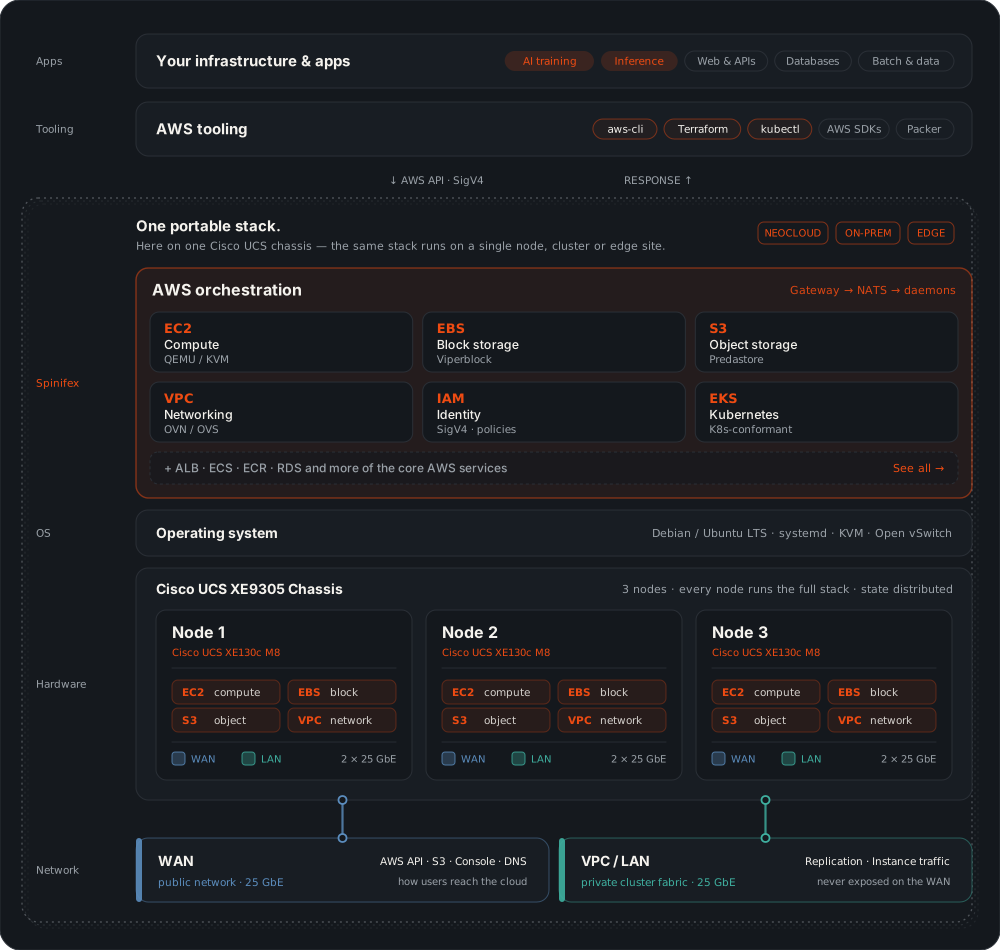
Every layer in the diagram is open and off-the-shelf. The AWS tooling you already run — aws-cli, Terraform, kubectl, the SDKs — speaks the AWS API over SigV4 to a Spinifex gateway, which dispatches over NATS to the daemons behind EC2 (QEMU/KVM), EBS (Viperblock), S3 (Predastore), VPC (OVN/OVS), IAM and EKS, with ALB, ECS, ECR and RDS alongside them. Those sit on an ordinary Debian or Ubuntu LTS host running systemd, KVM and Open vSwitch, with no proprietary hypervisor and no external control plane underneath. The hardware is three XE130c M8 sleds in a single XE9305 chassis, every node running the full service set with state distributed across all three, and each sled carrying 2 × 25 GbE — the WAN side for the AWS API, S3, console and DNS that users reach the cloud on, and a private VPC/LAN fabric for replication and instance traffic that never appears on the public network.
Validated by us, verified by Cisco
We stood Spinifex up on Cisco's own hardware and confirmed the core surface runs end to end. Our test bench was a three-node Cisco Unified Edge cluster: each node a single-socket Intel Xeon 6543P-B (32 cores / 64 threads) with roughly 500 GiB of memory and four KIOXIA CD8P NVMe drives, wired over dual 25GbE, with an NVIDIA L4 passed through to a guest via VFIO on one node. We used it to run Spinifex services, including EC2-style compute, VPC networking and IAM, and measured the storage layer under sustained load. The methodology is published in our platform benchmark.
We also spun up a simple computer-vision pipeline (write-up in our vision pipeline benchmark) and benchmarked Intel's AMX instruction set against the L4 for LLM serving (our AMX vs L4 test).
Cisco's own engineering team then evaluated Spinifex on Unified Edge through their verification process, and that independent result is what led to our acceptance into the Cisco 360 Partner Program.
What the partnership means
Acceptance into the programme establishes Spinifex on Unified Edge as a recognised, validated solution. Procurement runs through the Cisco channel, and both companies support the deployment. Mulga Defense Corporation is listed in Cisco's partner locator.
Spinifex remains open-source under AGPL-3.0, and able to run fully self-contained with no external control plane. On Unified Edge you can lean on Cisco Intersight for connected, SaaS-based fleet management where that suits the deployment, or run Spinifex standalone where it doesn't.
Cisco's customers gain a validated, AWS-compatible cloud runtime for Unified Edge: AWS workloads move onto enterprise edge hardware without being rewritten, and inference runs next to where the data is created. On our side, Spinifex picks up a hardened, globally supported reference platform, with Cisco's supply chain and service organisation behind the hardware.
Spinifex on Cisco Unified Edge is available now — to discuss a deployment or request an evaluation, get in touch. Our thanks to the Cisco team for the validation work behind this partnership, and to the operators who made the case for an AWS-compatible cloud on hardware they own outright.