As the number of industries meaningfully adopting AI into their workflows increases, we see a correlated resurgence in concerns surrounding data sovereignty and security. We also see growing concerns about AI "getting out of its cage," driven by incidents such as the recent hack on HuggingFace by one of OpenAI's unreleased models. Both factors necessitate a re-evaluation of how businesses deploy, scale and manage their workloads and critical online services, and the extent to which they truly own their tech stack.
This article explores the typical options, as well as a new "air-gapped AWS" approach facilitated by Spinifex.
The spectrum of ownership
For some, rising hardware costs mean that engaging with a neo-cloud such as Hydra Host or ResetData constitutes sufficient "ownership". Access to baremetal and/or specialised "sovereign AI" platforms enable businesses to incorporate AI and scale their workloads in a manner that satisfies sovereignty and security concerns, whilst avoiding the upfront capital expenditure and scaling headaches of owning compute outright.
For others, neo-cloud providers are not enough. Certain industries, operational settings and mission profiles require true ownership of the underlying hardware. These requirements, however, lead to higher up-front costs, scaling difficulty, and the increased risk profile that comes with managing everything yourself — security, IAM, availability and beyond.
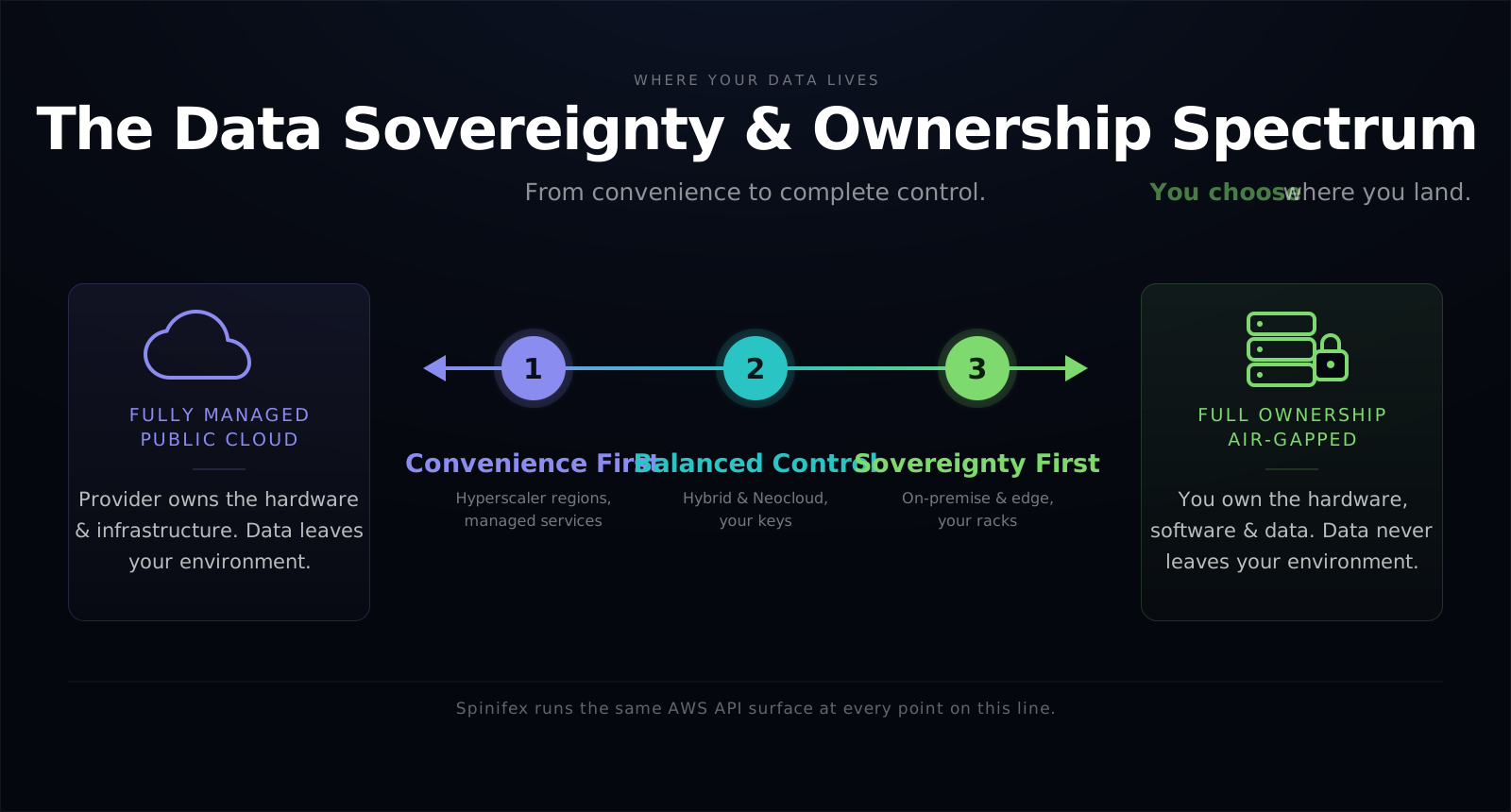
None of this is new. The spectrum of ownership has existed since the rise of cloud computing, but the rapid expansion of AI has forced organisations to reconsider where on it they want to sit.
Where Mulga stands
At Mulga, we lean hard to the right of the spectrum. We believe that full ownership and sovereignty over the tech stack will be essential in the coming years across an ever-growing number of industries. We made Spinifex to address the complications that come with that.
Spinifex replicates AWS services — S3, EBS and EC2 — as well as fully fledged workload management tools such as EKS and IAM, all on your own hardware. In doing so, it provides the ubiquitous cloud-native tools that have allowed businesses and their workloads to scale, manage access and authentication, and guarantee availability, but now with total control over how and where the workload runs.
Importantly, Spinifex has been designed to deploy and operate in air-gapped environments, so it satisfies the full spectrum of what data sovereignty means. Organisations that cannot justify purchasing their own hardware can use Spinifex in conjunction with a neo-cloud provider to ensure data is handled in accordance with whatever regulations apply to them. Organisations that can justify purchasing their own hardware can use Spinifex to ensure their data doesn't even leave the building, whilst scaling their operation with previously cloud-only tools.
The air-gapped Local Twin
In a world where AI is increasingly able to understand the structure of the cloud-native digital world and exploit it, and where data centers are becoming ever-more crucial strategic targets, a local, air-gapped AWS deployment may have benefits that extend far beyond data sovereignty and scalability. Using Spinifex to create an air-gapped "Local Twin" of your existing cloud deployment could afford organisations additional flexibility in how they choose to design their workloads against lack of connectivity.
This could take a number of different forms. Applications that require complete disconnection from day one, which would previously never have benefited from AWS-like tools, can be designed and deployed with tools like Terraform in mind. Alternatively, for orgnaisations seeking to build against potential future failure events, Spinifex could be incorporated as an additional availability zone to an already exisiting workload. This way, if your nearest data center or connection to it goes down, critical services operating in Spinifex's AZ can keep running. Then the only consideration is the extent to which your Spinifex "Local Twin" is a complete replica of your AWS deployment, or a simpler collection of the most crucial services.
And let's face it — given the state of the world right now, a scenario like that isn't all that far-fetched. Whether it be another "escaped AI" incident or an attack on a key data centre, remaining fully cloud dependent is increasingly becoming an operational risk.
Try it yourself
Check out Mulga's docs on how to set up your own air-gapped Spinifex installation here. Or sign up for our free hosted sandbox here.